








What this template is for
Hardware procurement is where IT teams either look organised or look chaotic - and the difference is usually whether the workflow lives in a ticketing tool with required fields, or in an email thread. Required spec, required budget code, required asset tag, required acknowledgement: that is the difference between a clean asset register and an annual audit panic.
This template makes the workflow the audit trail. Every hardware request is one Jira ticket with the same shape from request to asset tag.
When to use it
Use this template for:
- New-hire laptop and peripheral kit
- Hardware refresh (typically 3-4 years for laptops, 5+ for monitors)
- Damaged-device replacement
- Role-change hardware upgrade (engineer moving to a build-heavy role, designer needing colour-accurate display)
- One-off peripherals over a small de-minimis threshold
Sub-task breakdown
The sub-task chain - validate spec, approve budget, procure, receive, tag, image, ship, acknowledge - is the same on every request, so STM Issue Templates auto-creating them is a high-leverage configuration. The recipient acknowledgement sub-task in particular is the checkpoint that closes the loop and confirms the device made it to the right human.
Fields to add to your Jira create screen
These are the fields a project admin should make sure exist on the Create Issue screen for this issue type (Project settings → Screens). Without these on the screen, reporters can't provide the information triage needs - and STM can't reference them either.
| Field | Example value | Required |
|---|---|---|
Summary | MacBook Pro 16 M4 Max for @alex.chen (new hire) | Yes |
Requester | @line-manager | Yes |
Recipient | @alex.chen | Yes |
Hardware Type (custom) | Laptop / Monitor / Headset / Phone / Other | Yes |
Specification (custom) | MacBook Pro 16, M4 Max, 64GB, 2TB | Yes |
Reason (custom) | New hire / Refresh (4y old) / Damaged / Role change | Yes |
Budget Code (custom) | ENG-2026-CAPEX | Yes |
Estimated Cost (custom) | $4,200 | No |
Manager Approval | @line-manager | No |
Delivery Address (custom) | Home / Office - specify | No |
Asset Tag (custom) | Populated post-receipt | No |
Needed By | 2026-06-05 (start date) | No |
Note on custom fields. STM currently supports up to 5 custom fields per template. You can add as many custom fields as you like to your Jira Create Issue screen - the 5-field limit only applies if you want STM to set or update those custom fields itself.
Sub-tasks STM creates automatically
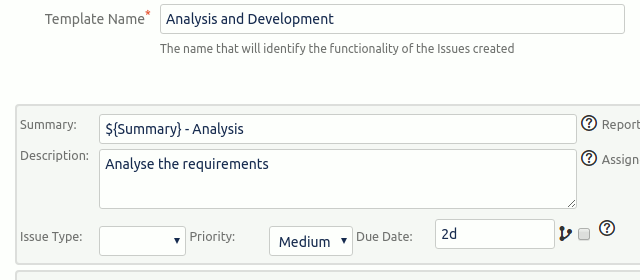
Build an STM sub-task template containing the items below, then wire it to an On Create Issue Executor scoped to this issue type. Whenever a new issue of this type is created in the project, STM creates the full sub-task set in one step - with assignee, due date, and components inherited from the parent unless you override them.
- Validate specification against role's hardware tier
- Get manager approval against the budget code
- Place the purchase order (procurement)
- Receive, asset-tag, and image the device
- Ship or arrange pickup, confirm delivery
- Recipient acknowledges receipt and signs the asset register
Common questions
What is a hardware request used for in Jira?
It is the ticketed flow that takes a hardware need from request to delivery - new-hire laptops, refresh cycles, damaged-equipment replacements, peripherals. The ticket captures the specification, approver, budget code, and asset tag, giving IT and finance a single audit trail per device from purchase order to receipt.
Should hardware requests have manager approval?
Yes, with budget-code attribution. Manager approval ensures the spend is intentional and routed to the right cost centre; the budget code lets finance close out the period. Auto-approving requests under a small threshold (say a $50 mouse) is fine, but anything over should pass through an approver.
How do you handle hardware refresh cycles in Jira?
Track the asset register in your IT asset management system (or in Jira with a Hardware issue type), and create refresh-request tickets per device as it crosses the age threshold (3-4 years for laptops). [STM Issue Templates](/stm/) can auto-create the refresh ticket per asset on a schedule so the refresh cycle runs itself rather than depending on whoever notices.
What sub-tasks should a hardware request have?
Spec validation, manager approval, procurement, receipt and asset tagging, imaging, shipping, recipient acknowledgement. The asset-tagging sub-task is the one that prevents devices going missing from the register - skipping it once costs years of audit-time hunting for that one orphan laptop.
Automate the sub-tasks with STM
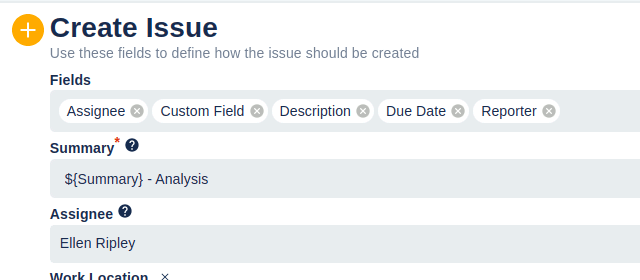
STM Issue Templates saves the sub-task list above as a reusable template and creates them on every new issue of this type - via an Executor on issue creation, on status transition, or triggered manually from the issue's "Create bulk sub-tasks" menu. STM does not change the parent issue's create screen (that's a Jira project-settings job) but it removes the manual work of creating the sub-tasks every time.
Try STM on the Atlassian Marketplace ↗ See how STM templates are built →