








What this template is for
A bad first day is the single most common predictor of an early resignation. A laptop that doesn’t arrive, an email account that doesn’t work, an access bundle that’s missing the one repository the new hire actually needs - any of these signals ‘this place is chaotic’ before the new hire has met the team.
This template makes day-one work by making it a tracked workflow that starts two weeks before the hire date. Hardware, base SaaS bundle, role-specific access, and day-one verification are all sub-tasks against a single parent ticket the IT team owns.
When to use it
Use this template for:
- Every new full-time hire
- Every contractor with company hardware or SaaS access (lighter sub-task set is fine)
- Every internal transfer that materially changes access (engineer moving to security team)
Day-zero changes (a hire’s start date being moved) update the same ticket rather than creating a new one.
Sub-task breakdown
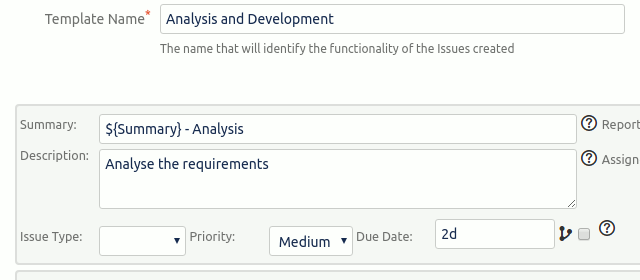
STM Issue Templates can lay down the right sub-tasks based on the Hardware Tier and Role Bundle fields. An Engineer hire’s onboarding ticket gets one sub-task set; a Sales hire gets a different one. The week-one and 30-day check-in sub-tasks are the ones that catch what was missed - skipping those is how ‘we onboarded them’ becomes ‘we lost them in month two.’
Fields to add to your Jira create screen
These are the fields a project admin should make sure exist on the Create Issue screen for this issue type (Project settings → Screens). Without these on the screen, reporters can't provide the information triage needs - and STM can't reference them either.
| Field | Example value | Required |
|---|---|---|
Summary | IT onboarding - @new.hire (start 2026-06-10) | Yes |
New Hire Name (custom) | Alex Chen | Yes |
Start Date | 2026-06-10 | Yes |
Role / Team (custom) | Senior SWE / Payments Platform | Yes |
Location (custom) | Remote - Berlin | Yes |
Manager | @line-manager | Yes |
Hardware Tier (custom) | Engineer (MacBook Pro 16, 64GB) | Yes |
Base SaaS Bundle (custom) | Google Workspace, Slack, Jira, GitHub, 1Password | Yes |
Role-Specific Access (custom) | Engineer bundle - GitHub org, dev clusters | No |
Linked Hardware Request | PROJ-1520 | No |
Linked Access Requests | PROJ-1521, PROJ-1522 | No |
Day-One Check-in (custom) | Scheduled 2026-06-10 09:30 with @it-onboarding | No |
Note on custom fields. STM currently supports up to 5 custom fields per template. You can add as many custom fields as you like to your Jira Create Issue screen - the 5-field limit only applies if you want STM to set or update those custom fields itself.
Sub-tasks STM creates automatically
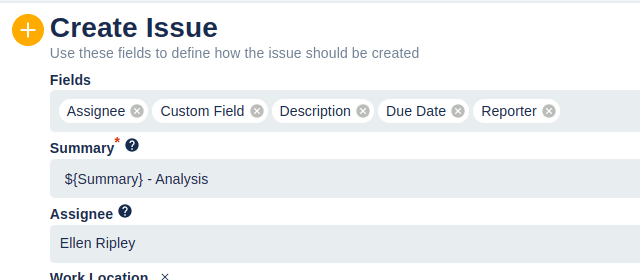
Build an STM sub-task template containing the items below, then wire it to an On Create Issue Executor scoped to this issue type. Whenever a new issue of this type is created in the project, STM creates the full sub-task set in one step - with assignee, due date, and components inherited from the parent unless you override them.
- Create accounts: identity provider, email, chat, ticketing, source control
- File hardware request and confirm device ships before start date
- Provision base SaaS bundle via SSO group membership
- Provision role-specific access via the appropriate role bundle
- Send pre-start welcome with day-one logistics, MFA setup, and security training
- Day-one check-in: confirm device, accounts, and access work end-to-end
- Week-one check-in: catch missing tools or access gaps
- 30-day check-in: close ticket with any remaining items resolved
Common questions
What is an IT onboarding ticket in Jira used for?
It is the parent ticket that coordinates everything IT does to make a new hire productive on day one - accounts, hardware, base access, role-specific access, and the check-ins that catch what was missed. Sub-tasks (or linked tickets to specialised templates like hardware-request and access-request) make the work parallelisable across the IT team.
How do you avoid day-one onboarding failures?
Three habits. Start the ticket two weeks before the start date. Use role bundles for SaaS and access rather than per-tool tickets - one Engineer bundle versus eleven separate access requests. Schedule the day-one check-in as a sub-task and treat it as a real meeting, because that is where you discover the missing licence or the wrong AD group.
Should IT onboarding be standardised by role?
Yes - define a hardware tier and an access bundle per role (Engineer, Designer, Sales, Operations). Standardisation makes the workflow predictable and catches the edge case (a contractor with a non-standard bundle) by exception. [STM Issue Templates](/stm/) can lay down the right sub-task set based on the role-bundle field, so the right work appears for the right role automatically.
What is the difference between IT onboarding and HR onboarding?
IT onboarding covers accounts, devices, access, and tools - the technical footprint. HR onboarding covers paperwork, payroll, benefits, and people processes. Both run in parallel for a new hire and both should be tracked, but they live in different workflows. The IT ticket links to the HR record but does not duplicate it.
Automate the sub-tasks with STM
STM Issue Templates saves the sub-task list above as a reusable template and creates them on every new issue of this type - via an Executor on issue creation, on status transition, or triggered manually from the issue's "Create bulk sub-tasks" menu. STM does not change the parent issue's create screen (that's a Jira project-settings job) but it removes the manual work of creating the sub-tasks every time.
Try STM on the Atlassian Marketplace ↗ See how STM templates are built →