








What this template is for
Competitive intel is famously easy to collect and hard to act on. Teams subscribe to alerts, file moves
into a spreadsheet, and never decide what to do about them. This template forces a decision: every
logged competitor move ends in a Recommended Response field and a sub-task that tracks the response
through to completion.
It is built for product marketing, product management, and sales-enablement teams who want competitive analysis to be a workflow rather than a feed.
When to use it
Use this template whenever a competitor makes a move that could affect positioning, pricing, or roadmap - feature launches, acquisitions, major hires, pricing changes, partnership announcements. Do not use it for low-signal noise (minor blog posts, conference appearances); aggregate those in a weekly digest instead.
How to set it up in Jira
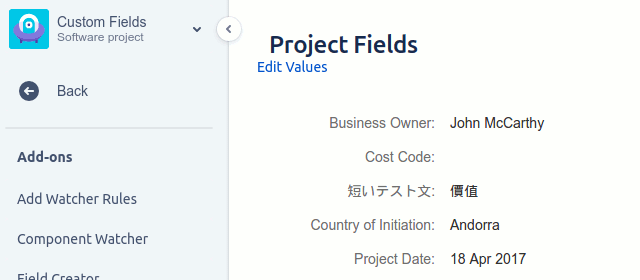
Build a competitive-intel project with the custom fields above on the Create Issue screen. Use Custom Fields select-list options for Move Type, Impact Assessment, and Recommended Response so dashboards are clean.
Sub-task breakdown
- Verify prevents the team from acting on a misreading or rumour.
- Brief ensures product and product marketing hear about it before sales does on a call.
- Update battle card keeps customer-facing collateral current.
- Decide and document locks the response so it cannot be re-litigated later.
- Track response carries the action through, often as a linked feature-request or marketing-campaign-brief.
Configure an STM Executor on this issue type so the five sub-tasks are auto-created on every competitor move - see /stm/.
Fields to add to your Jira create screen
These are the fields a project admin should make sure exist on the Create Issue screen for this issue type (Project settings → Screens). Without these on the screen, reporters can't provide the information triage needs - and STM can't reference them either.
| Field | Example value | Required |
|---|---|---|
Summary | Competitor - Acme launches AI summarisation feature | Yes |
Competitor Name (custom) | Acme Software | Yes |
Move Type (custom) | Feature launch / Pricing change / Acquisition | Yes |
Detected Date (custom) | 2026-05-22 | Yes |
Source (custom) | Press release, blog post, sales call | No |
Impact Assessment (custom) | High / Medium / Low | No |
Affected Personas (custom) | Ops Director Olivia, Engineering Manager Marco | No |
Our Current Position (custom) | What we offer today on this dimension | No |
Recommended Response (custom) | Counter-position, build, ignore, monitor | No |
Component/s | competitive-intel | No |
Labels | competitor-acme, 2026-q2 | No |
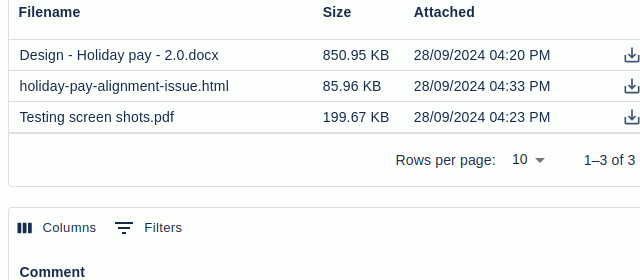
Attachments | Screenshots, press releases, recorded demos | No |
Note on custom fields. STM currently supports up to 5 custom fields per template. You can add as many custom fields as you like to your Jira Create Issue screen - the 5-field limit only applies if you want STM to set or update those custom fields itself.
Sub-tasks STM creates automatically
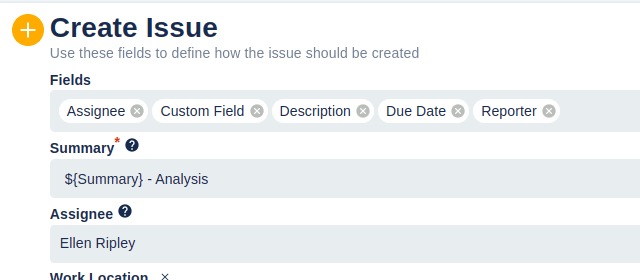
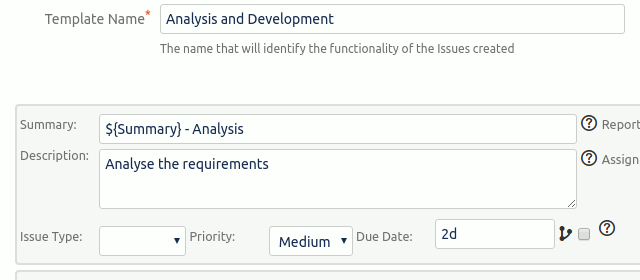
Build an STM sub-task template containing the items below, then wire it to an On Create Issue Executor scoped to this issue type. Whenever a new issue of this type is created in the project, STM creates the full sub-task set in one step - with assignee, due date, and components inherited from the parent unless you override them.
- Verify the move with two independent sources
- Brief product and product marketing
- Update battle card and competitor comparison page
- Decide and document the response
- Track the response action through to completion
Common questions
What is a Jira competitive analysis template?
It is a Jira issue type for logging a single competitor move - a feature launch, pricing change, acquisition, or positioning shift - with the structured context needed to decide how to respond. The template captures the move, source, impact, affected personas, our current position, and recommended response, plus sub-tasks for verification, briefing, and follow-up.
How do you track competitors inside Jira?
Create a competitive-intel project, then file one Jira issue per significant competitor move using this template. Tag with the competitor name as a label or component so you can filter for a single competitor's history. Link related moves into an Epic if they form a strategic theme (e.g. an entire AI roadmap rollout). Avoid a single monolithic 'competitor X' ticket.
Should competitive analysis live in Jira or a dedicated tool like Crayon?
Dedicated tools are better at automated signal collection. Jira is better at workflow - deciding, assigning, and tracking the response. Most teams ingest signals into a competitive-intel tool, then promote the ones worth acting on into Jira using this template. That keeps action items on the same backlog as product work.
What custom fields belong on a competitive analysis ticket?
Competitor name, move type, detected date, source, impact, affected personas, our current position, and recommended response. Configure these via Custom Fields with select-list options for the categorical fields (move type, impact) so you can build dashboards. Treat the recommended response field as the entry point to the sub-task workflow.
Automate the sub-tasks with STM
STM Issue Templates saves the sub-task list above as a reusable template and creates them on every new issue of this type - via an Executor on issue creation, on status transition, or triggered manually from the issue's "Create bulk sub-tasks" menu. STM does not change the parent issue's create screen (that's a Jira project-settings job) but it removes the manual work of creating the sub-tasks every time.
Try STM on the Atlassian Marketplace ↗ See how STM templates are built →