








What this template is for
A QBR is the moment the customer relationship moves from operational to strategic. It fails when the deck gets built the night before, when value claims are not backed by data, and when commitments made in the room evaporate the moment everyone leaves.
This template forces preparation to start four weeks out, requires evidence-backed value claims, and captures commitments as trackable Jira sub-tasks.
When to use it
Use this template for every QBR with a Tier 1 or Tier 2 customer. For smaller accounts, a periodic customer-health-check is usually sufficient.
How to set it up in Jira
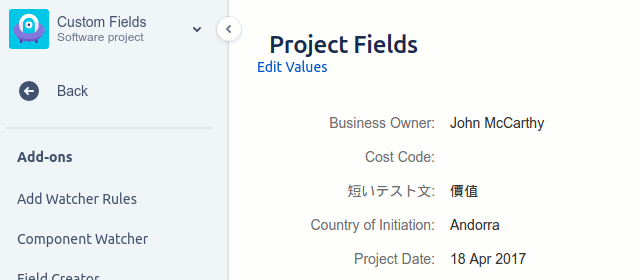
Create a customer-success project. Add the custom fields above to the Create Issue screen. Use Custom Fields for Quarter as a select list aligned to your OKR cycle. Required-on- create for account, quarter, and QBR date so dashboards roll up cleanly.
Sub-task breakdown
- Confirm QBR date and attendees locks logistics early.
- Pull value-delivered data and metrics is the evidence step.
- Align internal team on roadmap prevents on-stage surprises.
- Build the QBR deck is the artefact pass.
- Run the QBR is the meeting itself.
- Capture commitments and circulate follow-up turns conversation into action.
Use STM Issue Templates to auto-create the next QBR issue when the current one closes - see /stm-overview/.
Fields to add to your Jira create screen
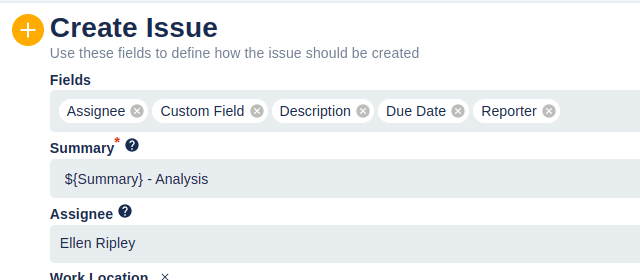
These are the fields a project admin should make sure exist on the Create Issue screen for this issue type (Project settings → Screens). Without these on the screen, reporters can't provide the information triage needs - and STM can't reference them either.
| Field | Example value | Required |
|---|---|---|
Summary | QBR - Acme Corp - 2026 Q2 | Yes |
Account / Customer (custom) | Acme Corp | Yes |
Quarter (custom) | 2026 Q2 | Yes |
QBR Date (custom) | 2026-06-25 | Yes |
Customer Attendees (custom) | Exec sponsor, ops lead, end users | No |
Our Attendees (custom) | CSM, AE, product, exec sponsor | No |
Value Delivered (custom) | Quantified outcomes this quarter | No |
Success Metrics Update (custom) | Against agreed customer KPIs | No |
Open Issues / Risks (custom) | Escalations, product gaps, satisfaction | No |
Strategic Roadmap Discussion (custom) | Customer priorities, our roadmap alignment | No |
Expansion / Renewal Topics (custom) | Growth opportunities, renewal context | No |
Outcomes / Commitments (custom) | Agreed next steps from the meeting | No |
Component/s | qbrs | No |
Labels | qbr-2026-q2, account-acme | No |
Attachments | QBR deck, value report, roadmap snapshot | No |
Note on custom fields. STM currently supports up to 5 custom fields per template. You can add as many custom fields as you like to your Jira Create Issue screen - the 5-field limit only applies if you want STM to set or update those custom fields itself.
Sub-tasks STM creates automatically
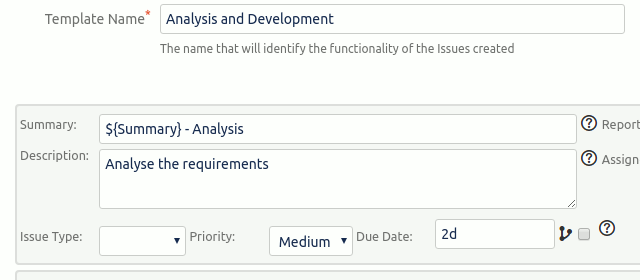
Build an STM sub-task template containing the items below, then wire it to an On Create Issue Executor scoped to this issue type. Whenever a new issue of this type is created in the project, STM creates the full sub-task set in one step - with assignee, due date, and components inherited from the parent unless you override them.
- Confirm QBR date and attendees
- Pull value-delivered and metrics data
- Align internal team on roadmap message
- Build the QBR deck
- Run the QBR
- Capture commitments and circulate the follow-up
Common questions
What is a Jira account QBR template?
It is a Jira task that captures the preparation and outcomes of a single customer's quarterly business review. It records attendees, value delivered, success metrics, open issues, roadmap discussion, expansion topics, and committed next steps. One issue per account per quarter creates a longitudinal record the account team can use to track strategic relationship momentum.
How do you prepare for a QBR in Jira?
Create one Jira issue per account QBR using this template four weeks before the QBR date. Pull value-delivered data and metrics early so internal alignment can happen before deck build. Use sub-tasks to ensure attendee confirmation, internal alignment, deck preparation, and follow-up commitments are all tracked. Link the QBR to the parent account Epic.
Should QBR prep live in Jira or in a slide deck?
The slide deck is the customer-facing artefact. The Jira issue is the internal workflow and audit trail - prep tasks, internal alignment, captured commitments. Keeping commitments in Jira makes them assignable and trackable, rather than buried in slide notes that are never read again.
What custom fields belong on a QBR ticket?
Account, quarter, QBR date, customer attendees, our attendees, value delivered, success metrics, open issues, roadmap discussion, expansion topics, and outcomes. Configure these via Custom Fields with required-on-create for account, quarter, and QBR date. The Outcomes field is the most important - it is what the follow-up sub-task draws from.
Automate the sub-tasks with STM
STM Issue Templates saves the sub-task list above as a reusable template and creates them on every new issue of this type - via an Executor on issue creation, on status transition, or triggered manually from the issue's "Create bulk sub-tasks" menu. STM does not change the parent issue's create screen (that's a Jira project-settings job) but it removes the manual work of creating the sub-tasks every time.
Try STM on the Atlassian Marketplace ↗ See how STM templates are built →