








What this template is for
OKRs go stale because the cadence is broken - they get written once, reviewed never, and scored in a last-minute scramble. This template makes the cadence explicit by attaching it to a single Jira issue per OKR with sub-tasks for the weekly, mid-quarter, and end-quarter steps.
It is built for leaders running team-level or company OKRs and want each one to be tracked the same way as the work that delivers it.
When to use it
Use this template at the start of every quarter for every OKR a team commits to. Do not use it for KPIs (steady-state metrics with no defined improvement target) or for individual goals - both belong in different artefacts.
How to set it up in Jira
Create an OKR project and add the custom fields above to the Create Issue screen. Mark Objective,
Quarter, and Team as required via Custom Fields screen rules. Link each OKR issue
to the parent company OKR using a Jira issue link of type aligns with or similar.
Sub-task breakdown
- Draft objective and key results is the proposal phase.
- Align with parent OKR ensures the OKR ladders up.
- Approve at planning session locks the commitment.
- Update confidence weekly keeps the OKR alive.
- Mid-quarter check-in lets the team correct course before scoring time.
- Score and retrospect is the explicit close-out.
Use STM Issue Templates to ensure the cadence sub-tasks are auto-created on every new OKR issue - see /stm-overview/.
Fields to add to your Jira create screen
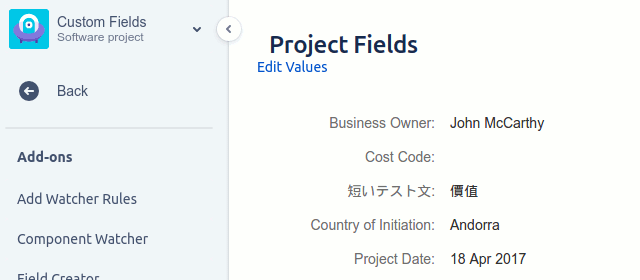
These are the fields a project admin should make sure exist on the Create Issue screen for this issue type (Project settings → Screens). Without these on the screen, reporters can't provide the information triage needs - and STM can't reference them either.
| Field | Example value | Required |
|---|---|---|
Summary | OKR - Increase activation rate to 45% in Q3 | Yes |
Objective (custom) | Make new users successful in their first week | Yes |
Quarter (custom) | 2026 Q3 | Yes |
Team / Function (custom) | Growth | Yes |
OKR Owner (custom) | Director of Growth | No |
Key Result 1 (custom) | Increase 7-day activation rate from 38% to 45% | No |
Key Result 2 (custom) | Reduce time-to-value from 14 days to 7 days | No |
Key Result 3 (custom) | Cut activation-blocked tickets by 30% | No |
Confidence (custom) | 0.5 (proposal) / weekly update | No |
Alignment / Parent OKR (custom) | Company OKR: Improve product-led growth | No |
Component/s | okrs | No |
Labels | okr-2026-q3, growth | No |
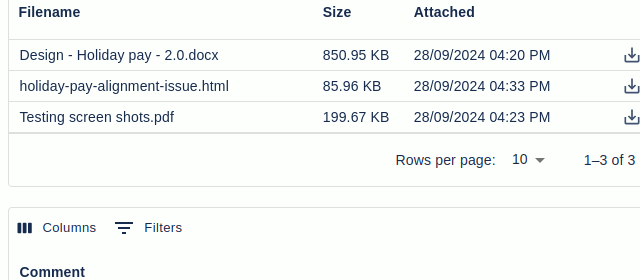
Attachments | Proposal doc, baseline metrics, review deck | No |
Note on custom fields. STM currently supports up to 5 custom fields per template. You can add as many custom fields as you like to your Jira Create Issue screen - the 5-field limit only applies if you want STM to set or update those custom fields itself.
Sub-tasks STM creates automatically
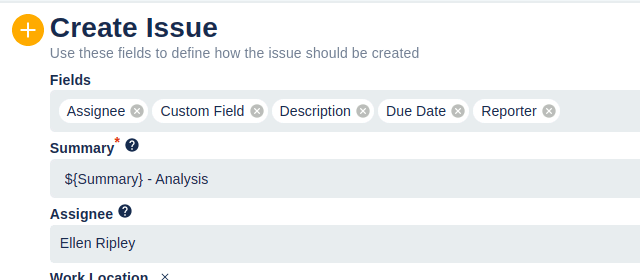
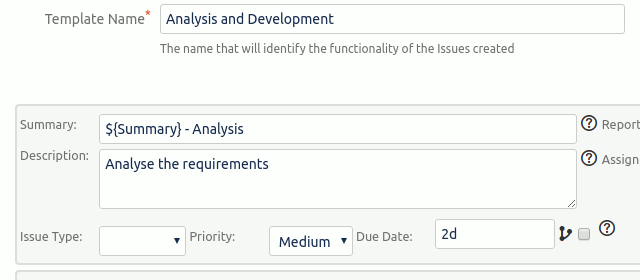
Build an STM sub-task template containing the items below, then wire it to an On Create Issue Executor scoped to this issue type. Whenever a new issue of this type is created in the project, STM creates the full sub-task set in one step - with assignee, due date, and components inherited from the parent unless you override them.
- Draft objective and key results
- Align with parent / company OKR
- Review and approve at the planning session
- Update confidence weekly through the quarter
- Hold the mid-quarter check-in
- Score and retrospect at end of quarter
Common questions
What is a Jira OKR quarterly template?
It is a Jira issue that turns a single objective and its key results into a tracked quarterly deliverable. It captures the objective, quarter, team, owner, individual KRs, confidence score, and parent-OKR alignment, with sub-tasks for proposal, approval, weekly updates, mid-quarter check-in, and end-of-quarter scoring. Using one issue per OKR makes the cycle auditable.
How do you run OKRs in Jira?
Create an OKR project. File one Jira issue per OKR using this template at the start of the quarter. Update the confidence score weekly via the description or a custom field. Use sub-tasks to enforce the cadence (mid-quarter review, end-quarter scoring). Link OKR issues to the launches, feature-requests, and epics that contribute to them so progress is traceable.
Should OKRs live in Jira or in a dedicated OKR platform?
Dedicated OKR platforms (Ally, Mooncamp, Lattice) handle hierarchical rollup well. Jira is better at linking OKRs to the actual work that delivers them. Many teams keep the parent objective in the OKR platform and represent team-level OKRs in Jira so progress is calculated from real ticket throughput, not self-reported confidence.
How do you score OKRs at the end of the quarter in Jira?
Use the end-of-quarter scoring sub-task to record each KR's final score (0.0-1.0) and an overall objective score in the description. Tag the issue with the resulting score (e.g. okr-score-0.7) so you can build retrospective dashboards across quarters. Close the OKR issue only after the retrospective sub-task is done.
Automate the sub-tasks with STM
STM Issue Templates saves the sub-task list above as a reusable template and creates them on every new issue of this type - via an Executor on issue creation, on status transition, or triggered manually from the issue's "Create bulk sub-tasks" menu. STM does not change the parent issue's create screen (that's a Jira project-settings job) but it removes the manual work of creating the sub-tasks every time.
Try STM on the Atlassian Marketplace ↗ See how STM templates are built →