








Short definition
A work log in Jira is a single entry recording time spent on an issue by one user on a specific date, with optional comment. Work logs sum to the issue's Time Spent field and aggregate across issues, projects, and users for reporting and billing. Each entry has a timestamp, duration, author, optional description, and an optional adjustment to Remaining Estimate.
What a work log entry contains
Each work log entry on an issue stores:
- Author - the user who logged it.
- Date started - when the work was done (not necessarily when the entry was created).
- Time spent - the duration in Jira’s time format (
2h 30m,0.5d,90m). - Description - free-text comment about what was done.
- Remaining Estimate adjustment - how this worklog affects the issue’s Remaining Estimate (auto- reduce, leave unchanged, set new, manually reduce).
The author and date are independent: a user can log time on a previous date if they forgot to log it in the moment. That flexibility is essential but is also why “logged today, worked last week” patterns exist - useful to know when reading worklog data.
Worklog aggregations
Work logs roll up in several ways:
- Per issue: sum of all entries -> Time Spent field.
- Per user: sum of one user’s entries across issues -> personal timesheet.
- Per project: sum of all entries on issues in a project -> project effort.
- Per period: sum of entries with date started in a range -> weekly/monthly report.
Jira’s built-in time-tracking reports cover per-issue and per-user views. Cross-project rollups and billable / cost-code dimensions typically need a marketplace timesheet app or a custom dashboard gadget.
Editing and audit
Work logs can be edited or deleted by users with the appropriate permissions. This is convenient operationally (fixing a typo, correcting a date) but problematic for audit: the historical figure silently changes, and downstream reports recompute against the new data.
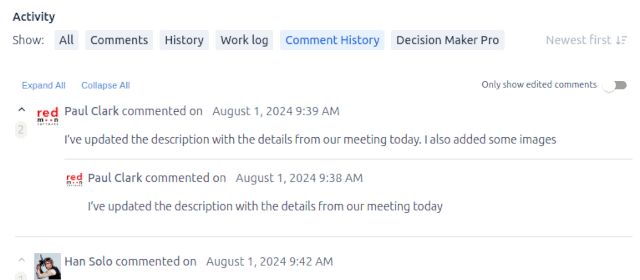
For contexts where worklog history must be preserved - client billing, regulated industries, contracts requiring an immutable record - Comment History captures every edit and deletion of worklogs (and comments) so the original entry is recoverable even after the user has changed it.
Worklogs vs. comments
Worklogs and comments often get conflated because both attach to issues and have authored text. The distinction:
- Comment - discussion about the issue. No time, no date-of-work, no rollup into Time Spent.
- Work log - record of effort. Always has a duration; rolls into Time Spent; not visible to users without the worklog permissions.
Putting “spent 2 hours today” in a comment instead of a worklog makes the data invisible to time reports. Worth flagging in onboarding.
See also (Redmoon products)
Common questions
What is a work log in Jira?
A work log in Jira is a single entry recording time spent on an issue by one user on a specific date, with optional comment. Work logs sum to the issue's Time Spent field and aggregate across issues, projects, and users for reporting and billing. Each entry has a timestamp, duration, author, optional description, and an optional adjustment to Remaining Estimate.
How do I log work on a Jira issue?
From the issue view, click 'Log work' (or use the keyboard shortcut). Enter the duration (e.g., `2h 30m`), the date the work was done, an optional description, and choose how Remaining Estimate is affected (auto-reduce, leave unchanged, set new value, or manual reduce). The entry is saved to the issue's history.
Can work logs be edited or deleted?
Yes. Users with the 'Edit Own Worklogs' / 'Edit All Worklogs' permissions can edit; 'Delete Own Worklogs' / 'Delete All Worklogs' can delete. Edits and deletes update the rolled-up Time Spent figure. For audit-sensitive contexts (billing, client invoicing), tools like Comment History capture worklog edits and deletions so the original record is preserved.
Can work logs be marked billable or have a cost code?
Not in standard Jira. Out of the box, a worklog has duration, date, author, and description - no billable flag, cost code, or rate. Marketplace apps add these via custom worklog fields, separate timesheet UIs, and rate cards. Teams doing billable work usually need at least one such app on top of Jira.