








Short definition
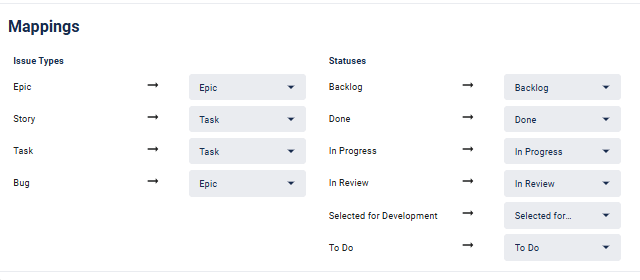
A Jira status is the current workflow state of an issue - for example To Do, In Progress, Code Review, Done. Statuses are nodes in a workflow, connected by transitions that move issues between them. Every issue is in exactly one status at any time, and every status belongs to one of three status categories: To Do, In Progress, or Done.
Statuses are global; workflows are local
A common confusion: a status is a global object in Jira (visible across the instance), but a workflow is
project- or issue-type-specific. The same Code Review status can appear in five different workflows
and mean slightly different things in each, because each workflow defines its own transitions in and out
of it. The status name is shared; its meaning is workflow-dependent.
This is why removing a status from one workflow doesn’t delete it from Jira - other workflows may still reference it. To fully delete a status, ensure no workflow uses it, then delete it from Statuses admin.
Status categories
Every status maps to one of three categories:
- To Do (grey) - work hasn’t started.
- In Progress (blue) - work is underway.
- Done (green) - work has finished.
Boards, reports, and JQL functions like statusCategory = Done use the category, not the status name.
That’s why a status’s category matters more than its name for reporting. A custom status called
Awaiting QA could be miscategorised as Done and silently break velocity charts - always double-check
the category when adding a status.
Status vs. resolution
These two fields together describe a finished issue:
- Status describes where the issue is in the workflow:
Closed,Done,Cancelled. - Resolution describes why it stopped being worked:
Fixed,Won't Fix,Duplicate,Cannot Reproduce.
A standard rule: any issue that leaves the active workflow should have a resolution. JQL like
resolution is EMPTY AND status = Closed finds the broken cases - issues that look closed in the UI but
have no resolution, which makes them re-appear in “open” filters elsewhere.
Statuses and notifications
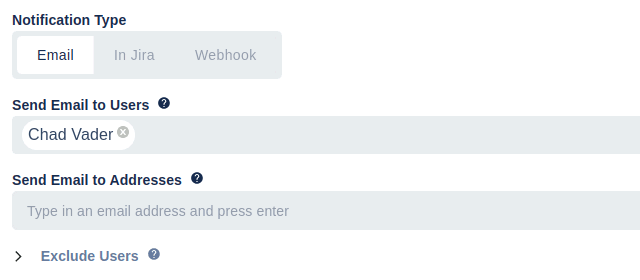
Most teams’ notification noise comes from too many status transitions firing notifications. Each transition can fire its own set of notifications via the project’s Notification Scheme. Auditing which transitions fire which notifications is the fastest way to reduce email volume without removing real signal.
Common questions
What is a status in Jira?
A Jira status is the current workflow state of an issue - for example To Do, In Progress, Code Review, Done. Statuses are nodes in a workflow, connected by transitions that move issues between them. Every issue is in exactly one status at any time, and every status belongs to one of three status categories: To Do, In Progress, or Done.
Status vs resolution - what's the difference?
Status is where the issue is in the workflow ('Done,' 'Closed,' 'Cancelled'). Resolution is why the work stopped ('Fixed,' 'Won't Fix,' 'Duplicate'). A closed issue should have both: a status indicating it's no longer active and a resolution explaining why. Empty resolution on a closed issue is a common source of reporting bugs.
How do I add a new status to a workflow?
Go to Jira admin -> Workflows -> edit the workflow -> Add status. New statuses must be assigned a status category (To Do / In Progress / Done) so reports and boards classify them correctly. Then add transitions from existing statuses to the new one. Publish the workflow to make changes live.
Can two projects share the same statuses?
Yes. Statuses are global to the Jira instance; workflows reference them. Two projects can use the same 'In Progress' status because it's a shared resource. This is why renaming a status affects every workflow that uses it - approach renames cautiously on instances with many workflows.