








Short definition
A parent issue in Jira is the issue that sits one level above another in Jira's hierarchy. A sub-task's parent is its standard-level issue (Story / Task / Bug); on Jira Cloud, a standard issue's parent is its epic. The parent relationship is one-to-many: a parent can have many children, but each child has exactly one parent.
Parent-child semantics
Jira’s hierarchy has up to three levels in the default model:
- Epic (top) - large body of work.
- Standard issue - Story, Task, Bug, or any custom standard-level type.
- Sub-task (bottom) - small piece of work under a standard issue.
The parent field connects each level to the next one up. On Jira Cloud the same parent field handles
both relationships. On Jira Data Center, the parent field is for sub-task-to-standard relationships and
Epic Link is for standard-to-epic - functionally similar but separate fields.
Children inherit nothing automatically beyond a few sub-task-specific defaults (assignee, due date, components, labels - and only when blank on the child). Otherwise the child is independent: its own assignee, status, workflow, comments, and worklog.
Parent-aware automation
The parent relationship powers many useful automation patterns:
- Auto-close parent when all children done. A rule with trigger “Issue transitioned to Done” and a branch over the parent’s other sub-tasks - if all are Done, transition the parent.
- Propagate priority changes. When the parent’s priority changes, update all sub-tasks’ priorities too.
- Inherit components. When a sub-task is created with no component, copy the parent’s component.
These rules treat the parent issue as a source of truth and the children as derived.
Field inheritance for sub-tasks
When a sub-task is created, several fields default to the parent’s values if blank on the sub-task:
- Assignee
- Due date
- Components
- Labels (some Jira versions)
- Affects Versions / Fix Versions
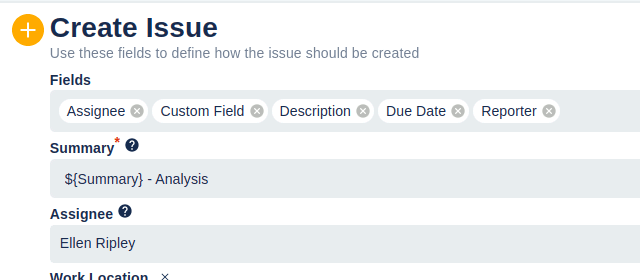
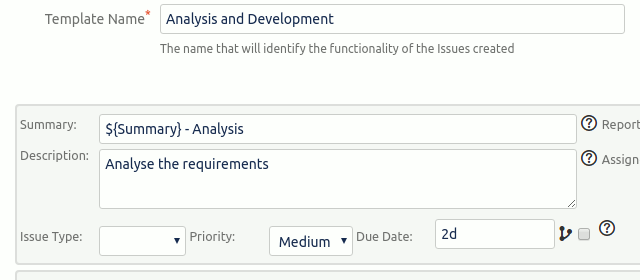
The inheritance is one-shot at creation - changing the parent’s assignee later doesn’t update existing sub-tasks. STM Issue Templates extends this inheritance: a template can pull from parent fields at sub-task generation time, including custom fields and structured data that vanilla Jira doesn’t inherit.
Cross-project parents
By default, parent relationships are project-scoped. A sub-task lives in the same project as its parent and cannot be moved separately. Epic relationships are project-scoped on Data Center; on Cloud they can cross projects via Plans. For genuinely cross-project work, Issue Links are the right tool - they form a graph rather than a tree, and they’re explicitly project-agnostic.
See also (Redmoon products)
Common questions
What is a parent issue in Jira?
A parent issue is the issue that sits one level above another in Jira's hierarchy. A sub-task's parent is its standard-level issue (Story / Task / Bug); on Jira Cloud, a standard issue's parent is its epic. The parent relationship is one-to-many: a parent can have many children, but each child has exactly one parent.
Can a Jira issue have multiple parents?
No. The parent relationship is exactly one-to-one from a child's perspective: a sub-task has one parent, a story has one epic. If you need many-to-many relationships, use Issue Links (`relates to`, `is part of`) which form a graph rather than a tree. Multiple-parent attempts are the most common reason teams move to linked-issues instead.
How do I find all issues that share a parent?
JQL: `parent = ABC-123` returns every direct child. On Jira Cloud this catches both sub-tasks and standard issues under an epic. On Data Center, sub-tasks use `parent = ABC-123` and standard issues under an epic use `"Epic Link" = ABC-123`. Combine with `OR` if you need both.
What happens to children when a parent is deleted?
Deleting a parent that has sub-tasks deletes the sub-tasks too (Jira warns before doing it). Deleting an epic does not delete its child stories - the children become orphans with an empty Epic Link / parent field. Both operations are destructive; bulk-edit or close issues first if you only want to clean up the parent.